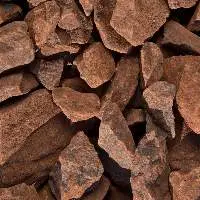
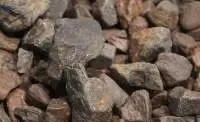
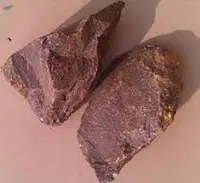
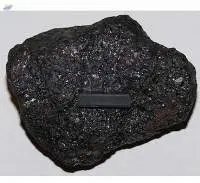
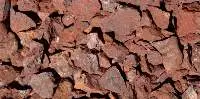
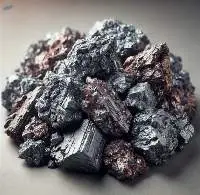
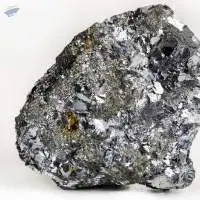
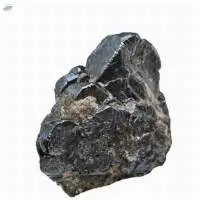
Iron ores are rocks and minerals from which metallic iron can be economically extracted. The ores are usually rich in iron oxides and vary in color from dark grey, bright yellow, or deep purple to rusty red. The iron is usually found in the form of magnetite (Fe3O4, 72.4% Fe), hematite (Fe2O3, 69.9% Fe), goethite (FeO(OH), 62.9% Fe), limonite (FeO(OH)n(H2O), 55% Fe) or siderite (FeCO3, 48.2% Fe).
Ores containing very high quantities of hematite or magnetite (greater than about 60% iron) are known as natural ore or direct shipping ore, meaning they can be fed directly into iron-making blast furnaces. Iron ore is the raw material used to make pig iron, which is one of the main raw materials to make steel 98% of the mined iron ore is used to make steel.
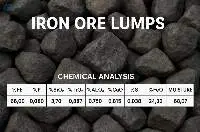
Item Specification
Fe: 57 Min
SiO2: 4 Max
Al2O3: 5.5 Max
Moist: 12 Max
P: 0.08 Max
S: 0.04 Max
+40mm: 5 Max
-6mm: 20 Max
LOI: 7 About
TI: 70 Min
AI: 15 Max
RI: 60 Min
RDI: 25 Max
DI: 10 Max
Iron Ore is fourth most common mineral present in the earth’s crust. However, nearly 70% of the world’s produce comes from China, Brazil, Australia, Russia and India. We extract the ores from the earth’s crust, either process it and convert it to pig iron and pellets. Iron ore is the key raw material in the production of steel – one of the most popular, versatile and robust materials used today in most of the industrial products.
Specification Descriptions
Fe 56% to 57%
SiO2 5.8% to 6.2%
Al2O3 4.9% to 5.3%
Moisture Content Upto 14%
P Upto 0.07%
S Upto 0.04%
Iron ore fines come from the natural raw iron ore through the process of mining, crushing and screening, where the iron ore is separated into lumps and fines. Iron ore is done in this fashion so that it can be used for the iron/steel making industry
Due to the high density of hematite relative to associated silicate gangue, hematite beneficiation usually involves a combination of beneficiation techniques.
One method relies on passing the finely crushed ore over a slurry containing magnetite or other agent such as ferrosilicon which increases its density. When the density of the slurry is properly calibrated, the hematite will sink and the silicate mineral fragments will float and can be removed.
We can supply good quantities of Iron ore from India,Middle East and CIS countries.
The key economic parameters for magnetite ore being economic are the crystallinity of the magnetite, the grade of the iron within the banded iron formation host rock, and the contaminant elements which exist within the magnetite concentrate. The size and strip ratio of most magnetite resources is irrelevant as a banded iron formation can be hundreds of meters thick, extend hundreds of kilometres along strike, and can easily come to more than three billion or more tonnes of contained ore.
The typical grade of iron at which a magnetite-bearing banded iron formation becomes economic is roughly 25% iron, which can generally yield a 33% to 40% recovery of magnetite by weight, to produce a concentrate grading in excess of 64% iron by weight. The typical magnetite iron-ore concentrate has less than 0.1% phosphorus, 3â??7% silica and less than 3% aluminium.
Currently magnetite iron ore is mined in Middle East,Australia& Canada Magnetite bearing banded iron formation is currently mined extensively in Brazil, which exports significant quantities to Asia, and there is a nascent and large magnetite iron-ore industry in Australia.
We can supply Iron ore from lower grade of 40% Fe to 65% Fe.
Magnetite is magnetic, and hence easily separated from the gangue minerals and capable of producing a high-grade concentrate with very low levels of impurities
The grain size of the magnetite and its degree of commingling with the silica groundmass determine the grind size to which the rock must be comminuted to enable efficient magnetic separation to provide a high purity magnetite concentrate. This determines the energy inputs required to run a milling operation.
Mining of banded iron formations involves coarse crushing and screening, followed by rough crushing and fine grinding to comminute the ore to the point where the crystallized magnetite and quartz are fine enough that the quartz is left behind when the resultant powder is passed under a magnetic separator.
Generally most magnetite banded iron formation deposits must be ground to between 32 and 45 micrometers in order to produce a low-silica magnetite concentrate. Magnetite concentrate grades are generally in excess of 70% iron by weight and usually are low phosphorus, low aluminium, low titanium and low silica and demand a premium price.
Heavy and relatively hard oxide
mineral, ferric oxide (Fe2O3), that constitutes the most
important iron ore because of its high iron content (50 to 60
to 70+ percent) and its abundance.
This premium-grade iron ore offers a balanced composition, meeting industrial standards for use in steel manufacturing, construction, and other metallurgical applications. It is processed to provide optimal purity and mineral content, ensuring consistency in quality for various industrial uses.
Applications: This iron ore is suitable for:
Steel manufacturing
Metallurgical applications
Construction materials
Advantages:
High purity and minimal impurities
Consistent composition for predictable processing outcomes
Low levels of undesirable elements like sulfur and phosphorus
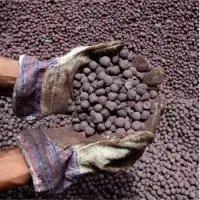
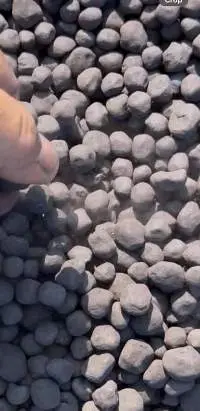
Iron ore steel pellets are small, spherical balls of iron ore, typically 8-16mm in diameter, that are produced from finely ground iron ore concentrate. These pellets are a crucial input in steelmaking, used in blast furnaces and direct reduction plants to produce hot metal and ultimately, steel. The pelletizing process involves binding the iron ore fines, often with binders like bentonite, and then hardening them through heating.
This by-product derives from the iron industries and its a valuable material for melting and manufacturing of ferrock for construction purposes.As a leading supplier of eco-conscious materials, we take pride in offering a diverse range of recycled materials, including cryolite, carbon anodes, carbon dust, bath material, steel scrap, fine iron scrap, rebars and more. With a strong commitment to sustainability, our materials are engineered to meet the demanding needs of industrial projects while promoting environmental responsibility.
Gremlog Trading DMCC stands at the forefront of the metal recycling industry, offering a meticulously curated selection of carefully sourced and recycled metal scrap solutions. Our comprehensive range includes:
Cast Iron Scrap: Our cast iron scrap, derived from the recycling process, is subjected to thorough quality checks, ensuring its suitability for applications requiring robust and high-performance cast iron.
Aluminium Scrap: Crafted from precise recycling processes, our aluminium scrap adheres to stringent purity standards, ensuring optimal performance in the production of high-quality aluminum alloys.
Steel Scrap: Derived from the efficient recycling process our steel scrap undergoes rigorous processing to meet exacting specifications, guaranteeing consistency and reliability for diverse industrial applications.
Rebars: Our meticulously sorted and processed rebars are characterized by its uniformity and purity, ideal for applications demanding precise metallurgical properties.
Fine Iron Scrap: Engineered for excellence, our fine FE scrap undergoes advanced processing, delivering a product that meets the stringent demands of modern manufacturing processes.
Our cast iron scrap, derived from the recycling process, is subjected to thorough quality checks, ensuring its suitability for applications requiring robust and high-performance cast iron.
Engineered for excellence, our fine FE scrap undergoes advanced processing, delivering a product that meets the stringent demands of modern manufacturing processes.
This by-product derives from the iron industries and its a valuable material for melting and manufacturing of ferrock for construction purposes. As a leading supplier of eco-conscious materials, we take pride in offering a diverse range of recycled materials, including cryolite, carbon anodes, carbon dust, bath material, steel scrap, fine iron scrap, rebars and more. With a strong commitment to sustainability, our materials are engineered to meet the demanding needs of industrial projects while promoting environmental responsibility.
This by-product derives from the iron industries and its a valuable material for melting and manufacturing of ferrock for construction purposes. As a leading supplier of eco-conscious materials, we take pride in offering a diverse range of recycled materials, including cryolite, carbon anodes, carbon dust, bath material, steel scrap, fine iron scrap, rebars and more. With a strong commitment to sustainability, our materials are engineered to meet the demanding needs of industrial projects while promoting environmental responsibility.
Ferric oxide 59.60%
Aluminum Oxide 13.90%
Sulfur dioxide 11.86%
Magnesium oxide 6.60%
Silicon dioxide 4.20%
Calcium oxide 2.70%
Manganese(II) oxide 0.39%
Nickel oxide 0.14%
Chromic oxide 0.14%
copper (II) oxide 0.08%
Titanium dioxide 0.07%
Potassium oxide 0.06%
Strontium oxide 0.05%
Vanadium oxide 0.03%
Zinc Oxide 0.03%
This by-product derives from the iron industries and its a valuable material for melting and manufacturing of ferrock for construction purposes. As a leading supplier of eco-conscious materials, we take pride in offering a diverse range of recycled materials, including cryolite, carbon anodes, carbon dust, bath material, steel scrap, fine iron scrap, rebars and more. With a strong commitment to sustainability, our materials are engineered to meet the demanding needs of industrial projects while promoting environmental responsibility.
High-Grade Titanium Dioxide Concentrate Ore is a premium titanium-bearing mineral concentrate derived from Rutile and upgraded Ilmenite through beneficiation processes.
TiO content: 90% - 96% (high grade)
FeO: 1.5% - 3%
SiO: 0.5% - 1.5%
AlO: 0.3% - 1%
Moisture: 0.1% 0.5%
Particle size: 63 - 180 microns
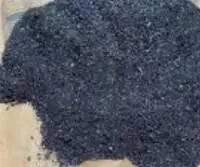
Appearance: Dark brown / reddish brown / black sand
Specific gravity: 4.2 - 4.6 g/cm
Magnetic content: Very low (high purification level)