Supplier From
Shijiazhuang City,
China
Supplier From
Shijiazhuang City,
China
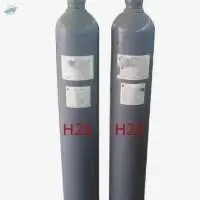
Hydrogen sulfide is a hydride of sulfur with the chemical formula H2S. It is a colorless, foul-smelling (rotten egg) highly toxic gas. It is soluble in water and ethanol, with a specific gravity of 1.1906. The melting point is -85.5�°C, the boiling point is -60.4�°C, the critical temperature is 100.4�°C, and the critical pressure is 90.06�?105 Pa. The autoignition point is 260�°C, and it is flammable. It can cause explosive combustion when it encounters a spark. When mixed with air, it can cause an explosion, and the explosion limit is 4% to 44% (volume). It can react chemically with a variety of ions to produce water-insoluble sulfides, which can turn the surface of copper and silver black. It is widely present in the manufacturing industries of metal smelting, natural gas, hydrochloric acid and sulfuric acid. When manufacturing various sulfides such as sulfate pulp, rayon, artificial cotton, rubber, carbon disulfide, etc., hydrogen sulfide gas is often discharged. In some chemical reactions, unstable sulfur-containing compounds will also decompose into hydrogen sulfide. For example, in coking, refined petroleum and metal smelting, hydrogen sulfide, as a conventional waste gas, is very easy to leak into the air. The decomposition of sulfur dyes can also release hydrogen sulfide gas.
Chemical properties Hydrogen sulfide is a colorless, acidic gas with a rotten egg-like odor. Relative density 1.5392 (0â??). Melting point 85.5â??. Boiling point -60.3â??. Critical temperature 100.5â??. Critical pressure 9.0�?103Pa. Heat of vaporization 18.67kJ/mol; heat of fusion 23.80kJ/mol. Vapor pressure 2.7kPa (25.5â??). Vapor relative density 1.19. Ignition point 260â??. Explosion limits: lower limit is 4.3% (volume), upper limit is 40.0% (volume). The allowable concentration in the air is 10�?10-6 (ppm). Soluble in water, ethanol, glycerol, Chemicalbook, carbon disulfide. Extremely soluble in organic amines. Also highly soluble in caustic soda solutions. Burns in excess oxygen to produce sulfur dioxide and water, and produces water and free sulfur when oxygen supply is insufficient. Stable at room temperature. Uses Hydrogen sulfide is used in the synthesis of phosphors, electroluminescence, photoconductors, photoelectric exposure meters, etc. Reducing agent for organic synthesis. Used in metal refining, pesticides, medicines, and catalyst regeneration. General reagent. Preparation of various sulfides. Uses Used to separate and identify metal ions, purify hydrochloric acid and sulfuric acid, and prepare elemental sulfur Uses Can be used to convert sulfur and sulfuric acid, produce sodium sulfide and sodium hydrosulfide, or to produce organic sulfur compounds such as thiophene, mercaptans, and thioethers